
When I was growing up in India, any kind of pre-packaged beverage was a rather strict no-no in my home. We never had any kind of soda sitting in the fridge. I’d seen Pepsi or Coca-Cola bottles in some friends’ homes and knew people consumed such drinks but it just wasn’t a part of my life. Once, my uncle had bought me a bottle of Coke and I remember taking a sip and coughing due to the unfamiliar sensation. While my uncle probably thought he was giving me a taste of something awesome I was normally deprived of, that incident put me firmly in the same camp with my parents – in the Carbonated-Drinks-Are-Bad camp. Somehow, I stayed in that camp in spite of the constant and creative advertising campaign by both soda behemoths.
That mindset carried over as an adult when I learnt about the health problems cause by such beverages, the way these companies were exploiting the water resources in countries where the residents suffered in droughts and the damage caused to our environment due to the plastic wastage. To save some ink (pixels?), I’m not a fan of either PepsiCo or their competitor. So, I had no interest in reading about the life of the CEO of an ‘evil’ company and would not be giving any of my hard earned money to her, even if she was Indian.
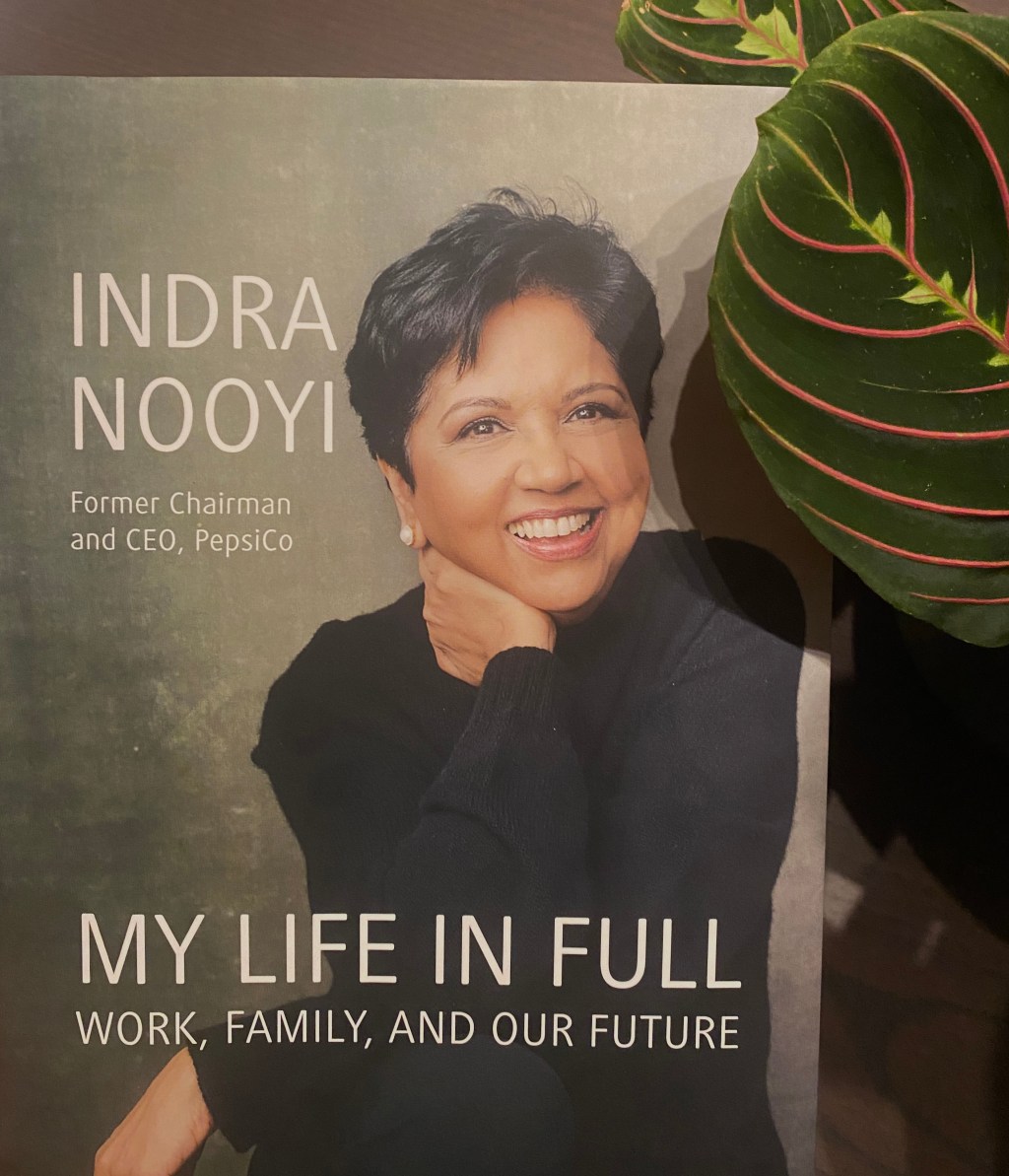
Podcasts, newspaper articles, friends and even my father mentioned her new book to me and referred to her as a role model for people like me (person of color, woman, India, American) , a ‘great’ woman. It was my father’s words that brought me close to giving it a try. And then, I spotted the book on a friend’s bookshelf and asked if I could borrow it. This was a great solution – I could give Indra a chance while not adding twenty bucks to her bank vault. Plus it would bring me a step close to my goal of reading 24 books in 2022.
In the beginning, the book is rather dry and bland. I did enjoy the some descriptions of Indra growing up in India because I related to them; such as bathing in one bucket of water which had been warmed on the stove, living on limited resources, the fun childhood days spent at school (apparently something most Americans do not relate to) and some of the cultural aspects. On the other hand, some incidents and descriptions spelled overwhelming privilege which the author completely failed to acknowledge. Being in a rock band and listening to the latest trending western bands such as the Beetles might be normal for American teenager during that time, but completely out of the ordinary for Indian teens (I checked with my mom!). It may have been normal in a metropolitan city like Chennai but it is more likely that Indra’s family being affluent had something to do with this.
From being in a rock band in her school years to undergrad to grad school at IIM and Yale, Indra sails through everything. She was hard working in intelligent. So, when a problem arose, her hard work, intelligence and her family’s support got her through it. Sexism, racism, child care problems, house buying problems, corporate problems – just hard work and reliance on family. This seemed like her “Raam Baan” or single solution to every problem.
Reading about this supposed role model, I struggled to feel inspired. In fact, I was constantly frustrated by her lack of doing any thing meaningful. She consistently put her employers needs above her own and her family’s. And consistently kept getting promoted and being surprised by it. The whole thing made me feel like she was drifting up the corporate chain because she was an intelligent workaholic: a winning combination. She never expressed ambition to anything and yet kept working insane hours. Her story shows her gaining bigger and bigger positions but never using them to better the situation of women in the work force or the bad effect her company was having on people and the environment. Till about three quarters of the way through the book. Around this point, Indra is appointed to be the CEO of PepsiCo (again, not something she was gunning for and was completely shocked by).
As CEO she finally set about finding ways she could influence change. She started the “Performance with Purpose” thingy at PepsiCo which is intended to make their products more nutritious and less of a drag on the environment. I call this a “thingy” because I did not understand exactly what it was. It did not seem tangible to me and it was unclear how it would be applied to what the company did and sold. Anyways, under this umbrella, she also made PepsiCo a better workplace for women and parents by allowing more flexible work and taking seriously all claims of sexual harassment. Both great actions! I particularly loved the episode of her writing to employee’s parents telling them what a great job their kids were doing at PepsiCo the world. It was touching and I could imagine the joy and pride the parents would have felt reading such letters from a person of such import. She also finally gets to talking about the meatier issues in this last quarter of the book – family vs work, sexism in the work place – both overt and subtle and PepsiCo’s impact on the planet and its people. I really enjoyed this part of the book. It pulled back the curtain a teeny bit and let the reader see a silhouette of Indra but just that. Not much details, no colors.
I wanted to understand the thoughts behind her work. I wanted to know why Indra did not make substantial changes to PepsiCo that seriously reduce its negative effects on society. Why did she not divest from plastic packaging completely? In her own career, she had experienced lower pays than her male counterparts. Why had she not done anything as CEO to correct this in a systematic manner? Why did she sacrifice time with her family against her own wishes for her work? As a woman in power, she had the means to ask for this space. Countless women on the lower rungs of the ladder would have given anything to be able ask for such flexibility. Why did she not take the opportunity.
Unsurprisingly, on these, and many other questions, I got no answers. Thus, my deep disappointment. I was had hoped to be able to admire this role model.
However, it isn’t that I learned nothing from this read. It reinforced a lesson I have been trying to ingest for a while. The People we admire are multifaceted. The people we admire have some good qualities in large magnitudes but they almost always have some negative traits as well. The current culture is very against allowing people their flaws. If someone rich and famous did one bad thing or have one bad aspect to their personality, their whole life and work is deemed bad and not worth praise. This black and white perception of public figures leads us to not only bereft of idols but also makes us expect perfection from ourselves. Because if we aren’t perfect we are bad, garbage, useless. Cue an anxious generation.
So, I try to take the best from people. This does not come naturally, like at all (hence the ranting in the paragraphs above), I have to make a practice of it. It is something I notice my husband is good at and I try to copy him, hoping it will become second nature to me as well.
Here goes. The best of Indra was her incredible work ethic and her eagerness to dive into a topic and learn the basics so when she was looking at the big picture, she wasn’t making mistakes due to not knowing the small details. She never verbalized this but she was extremely adaptable throughout her career. No matter what challenge was thrown her way, she pivoted to keep moving forward. I admired her for admitting the regrets she felt about missing out on time with her family. This is something I intend to consider when I have children of my own and need to manage my time. I truly felt for her when she described her mom telling her to leave her crown outside when she wanted to share the news of being promoted to CEO. The downplaying of women’s achievement is nothing new to me. So this one stung me as well. However, Indra was able to extract the positive from this rebuke as well. Always seeing the positive, always moving forward. Dwelling too deeply on the negative could mean conflict and time wasted on unproductive back and forth (IMO much like bickering on reddit). So, she took the best and moved forward. Keep going, chale chalo. And I think I found a quote the distills why I feel the disappointment I do about her work. She says:
”I sought purpose in every one of my consulting jobs …”.
And not sought jobs with a purpose, which is my way of looking at employment. Understanding this difference allows me to understand her choices, if not agree with them. There were many such details in the book that made me relate to her more and root for her and understand where she came from a teeny bit better. And I think, in the grand scheme of things, it is okay that she did not make large, sweeping, progressive changes. I have come to think it is enough that she simply broke that glass ceiling in her industry. That alone is enough for one person.
While I take issue with a lot of decisions Indra made, I was also not in her shoes. I do not know where she was in her journey as a person (even though I read the book). May be in her place, I would have done different things, may be not. I cannot know. But I do know, her having been in a position of such power, opened the doors many young girls being able to dream of themselves in similar boardrooms. And one can only hope that when they get there, they can press forward on the work that Indra could not or would not do.
 The Kapre-Anderson Project
Leave a comment